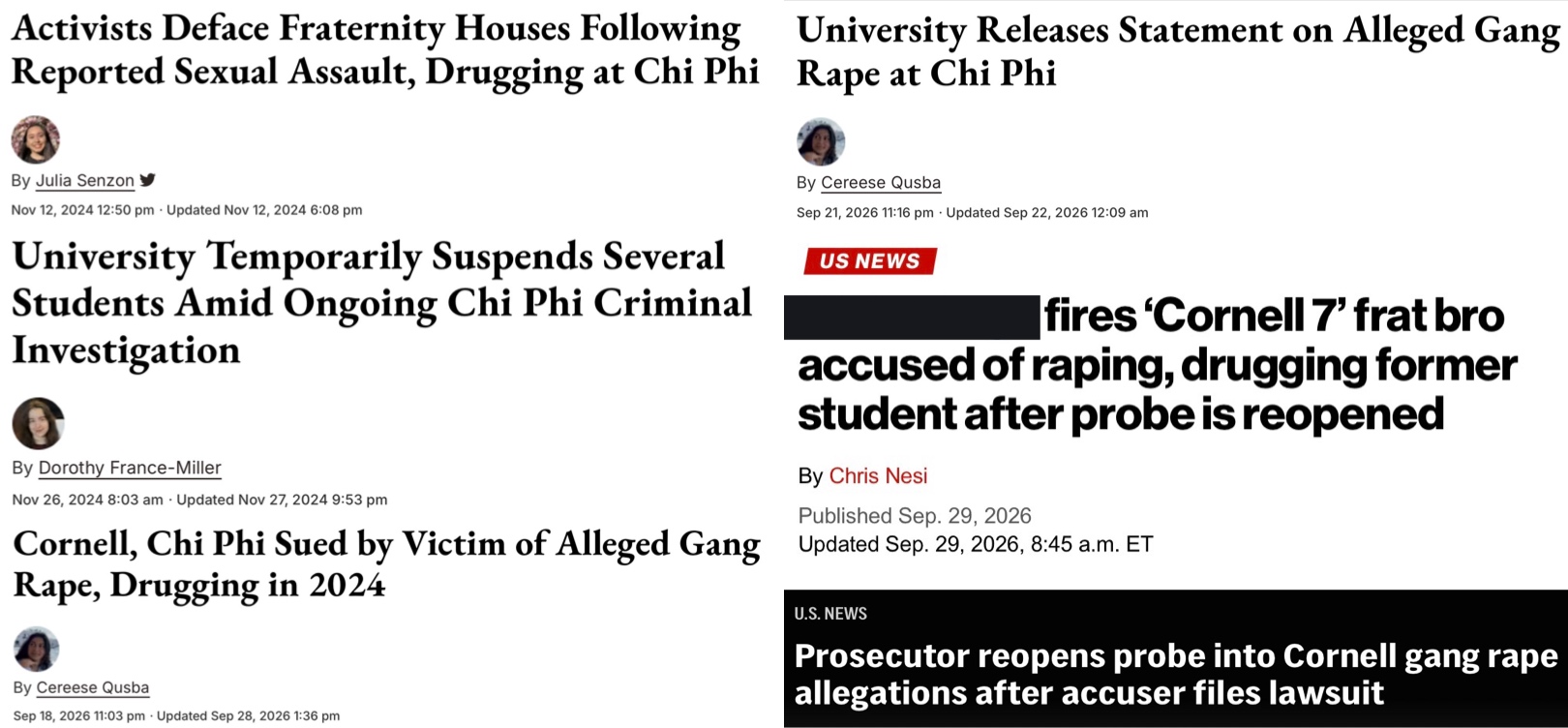
According to a civil complaint filed in 2026, a Cornell student identified in court papers as Jane Doe was drugged and sexually assaulted by seven members of the Chi Phi fraternity at the chapter house overnight. These allegations have not been established in court.
According to the lawsuit, Jane Doe reported the incident to Cornell University Police on or about November 8, 2024, a few weeks after the alleged assault. The Tompkins County District Attorney's Office says it received a sworn statement from her in November 2024.
On November 26, 2024, Cornell said the Chi Phi chapter had been under a temporary suspension order since November 8, 2024, for alleged violations of the Student Code of Conduct, and that temporary suspensions had been issued for a number of students as interim measures. Cornell has since said its Office of Civil Rights and Office of Student Conduct and Community Standards investigated and adjudicated the allegations over several months, and that the chapter was closed in 2024 and remains barred from campus. The lawsuit alleges that Cornell's Title IX hearings took place in May 2025.
The District Attorney's Office reviewed information from Cornell University Police and did not file charges. The District Attorney has since said the plaintiff's sworn statement at the time did not establish a lack of consent under state law, and that the decision was based on the information his office had then.
Jane Doe files a 101-page civil complaint in New York County Supreme Court. It names Cornell University, seven current and former students, fraternity and sorority organizations, and others, including a local bar. Reports differ on the filing date: some give September 14, the date on which the complaint is signed. The Governor's Executive Order No. 64 gives September 16.
Sources: The Ithaca Voice, CBC News. We do not link to the complaint itself because it contains details that could identify the plaintiff.
Tompkins County District Attorney Matthew Van Houten announces his office is reopening the case and will present it to a grand jury. The office says the sworn statement it received in November 2024 differs substantially from the allegations in the civil complaint.
The complaint alleges the students were temporarily suspended and allowed to mitigate their conduct by submitting essays. Cornell says none of them were offered the opportunity to write essays as a sole consequence, and that a hearing panel issued sanctions that included expulsions and suspensions. Cornell has not said which students received which sanctions, and the specific sanctions have not been independently verified.
Cornell publishes a list of questions and answers about its response, in an email signed by President Michael I. Kotlikoff, Provost Kavita Bala, and Board of Trustees chair Anne Meinig Smalling. It answers "No" to whether involved students "only had to write essays," and says it "imposed different sanctions based on the findings and circumstances involving each student," and that federal privacy law prevents it from giving "an individual-by-individual account." It also says Cornell University Police provided the Snapchat screenshot to the District Attorney "as part of the evidence supplied" in November 2024, which conflicts with what the District Attorney told ABC News. Cornell updated the page on September 30.
At a meeting with student government, President Michael I. Kotlikoff says two of the accused students were expelled, two were suspended for at least two semesters, one graduated before any sanction could be imposed, and two were found not responsible for sexual misconduct, according to CBS News. He did not say which student received which outcome. Cornell has not published these figures in a written statement.
New York Governor Kathy Hochul calls for "outside counsel to conduct a transparent, independent review of the university's response to determine whether Cornell met every obligation to protect its students and pursue justice." She says she supports the District Attorney's decision to reopen the criminal investigation. A Cornell spokesperson says the university "shares Governor Hochul's commitment to addressing campus culture issues."
A spokesperson for New York Attorney General Letitia James says the office is reviewing Cornell's response to the allegations, according to CNN. The office has not said what the review covers or what action, if any, it could take.
District Attorney says he did not receive the interview transcript
CBS News reports that it obtained, from a source, a transcript of the plaintiff's 2024 interview with Cornell University Police, which it says was the basis for her written statement. In it, according to CBS News, she says, "I can say with 100% confidence I was raped." District Attorney Matthew Van Houten tells CBS News that his office was never given the full interview transcripts, and that the sworn statement it received in November 2024 did not include that remark. We have not seen the transcript.
In a video, Governor Kathy Hochul says she spoke with President Michael I. Kotlikoff and that Cornell has agreed to an independent review of its response by outside counsel. She says to expect an announcement from the university "in a fairly short order." Cornell has not yet said who will conduct the review or what it will cover.
Cornell changes one answer in its FAQ at least twice, according to The Cornell Daily Sun and NPR member station WSKG. The original answer said Cornell University Police "shared all investigatory information" with the District Attorney's Office. On September 30 that sentence was removed; on October 1 it was replaced with a sentence saying the police shared "the victim's sworn statement and the Snapchat screenshot." The separate answer we quote in C7-E-020 has not changed.
District Attorney Matthew Van Houten tells NPR member station WSKG that he has not read the full account of the plaintiff's 2024 interviews with campus police and is trying to get the transcript from Cornell. He says he does not know when he will receive it "or if Cornell will resist turning it over." He says the transcript is part of Cornell's confidential Title IX investigation.
Governor Kathy Hochul signs Executive Order No. 64, appointing Attorney General Letitia James as special prosecutor. The order gives the Attorney General power to investigate the alleged assault and, "if warranted," present evidence to a grand jury and prosecute. It says her jurisdiction "will displace and supersede" that of the Tompkins County District Attorney. The order states that in November 2024 the District Attorney declined to prosecute "without speaking to Jane Doe" and relied in part on a sworn statement "which reportedly omitted key portions" of her account. Hochul says the new information "undercut my faith, and the public's faith, in the District Attorney's ability to effectively investigate and prosecute the case at this time."
The Attorney General says she is ready "to lead a process New Yorkers can trust, guided by the facts and the law." Cornell says it supports the decision. The plaintiff's attorney welcomes it, according to NBC News. The District Attorney did not immediately respond to NBC News.
Cornell's Student Assembly holds a public hearing on sexual violence, attended by about 100 people, and unanimously passes three resolutions about the case and sexual assault on campus, according to The Cornell Daily Sun.
Governor and Attorney General hold a news conference
Governor Kathy Hochul says the plaintiff was "failed" by people and institutions "with an obligation to protect her." She criticizes the District Attorney for closing the case without interviewing her "or anyone else involved, or even request[ing] the full transcript," and says her statement that she was "100% confident" she had been raped "never made it into the account that the Cornell police sent to prosecutors," citing news reports. The Attorney General will oversee the investigation and, if warranted, present evidence to a grand jury.
District Attorney says his office had some Snapchat messages
CNN reports that the District Attorney said this week his office had access to some Snapchat messages from the "Chi Phi Actives" group chat, and that it received no more than those messages and a six-page investigative report before deciding not to bring charges. Because this no longer clearly contradicts Cornell's statement that its police gave his office the Snapchat screenshot, we changed the label on C7-C-08 from Disputed to Unresolved.
In a video message, President Michael I. Kotlikoff calls it "one of the most difficult weeks" in Cornell's history. He says the university supports the special prosecutor's appointment and an independent review, will examine the role of fraternities and sororities, and will support changes to New York's sexual assault laws. "We owe it to Jane Doe and to survivors of assault to get this right," he says.
The New York Times reports that it obtained more than 1,000 pages of Cornell investigative records, police reports and interview transcripts. According to the Times, as reported by The Cornell Daily Sun, Cornell's Title IX hearing panel concluded that two of the seven students sexually assaulted the plaintiff. The outcomes it describes: two students expelled; two suspended and placed on disciplinary probation, with no-contact orders, educational modules and reflection papers; one, who had graduated, barred from campus for three years; and two given no-contact orders, educational modules and reflection papers. These are findings of a university process, not of a court. We have not seen the records, and we do not say which student received which outcome (see our privacy policy).
Thousands of students, faculty and Ithaca residents attend a "Justice for Survivors" rally on Ho Plaza organized by about 40 student groups, according to The Cornell Daily Sun. Speakers criticize Cornell's handling of the case; the graduate student union calls for President Kotlikoff to resign.
Trustees name Sally Yates to lead the independent review
A special committee of Cornell's Board of Trustees retains Sally Q. Yates, a former U.S. Deputy Attorney General, and the law firm King & Spalding to review how Cornell prevents and responds to sexual misconduct, including campus police, coordination with prosecutors, and fraternities and sororities. The review will include "a detailed review of the University's response to the allegations involving Jane Doe," and the board says it intends to share the results with the Cornell community. No timeline was given.
Defendant challenges the special prosecutor's appointment
Gillio Lopes, one of the seven students named as defendants, files a petition in Albany County Supreme Court against the Attorney General and the Governor seeking to block the Attorney General's appointment as special prosecutor. The petition says she has "unequivocally demonstrated a bias and presumption of guilt against the defendants named in the Civil Case." He has denied sexually assaulting the plaintiff, according to NBC News. The Attorney General's office declined to comment. No court has ruled on the petition.
More than 100 students hold a seven-hour sit-in at a campus dining hall in solidarity with the plaintiff, according to The Cornell Daily Sun. The same day, Ithaca's Common Council approves a temporary moratorium on student event permits, which mainly affects fraternities and sororities.
Second defendant moves to disqualify the special prosecutor
Lawyers for Winston Lee, one of the seven defendants, file a motion in Tompkins County asking a court to bar the Attorney General from the criminal investigation and any grand jury proceedings, and to have potential grand jurors asked whether they know of her public comments. The motion says she has "already publicly prejudged the guilt" of the men named in the lawsuit, citing her September 28 social media post supporting the plaintiff. Reports differ on whether it was filed on October 8 or 9. No court has ruled on it.
Judge sets a hearing on the challenge to the special prosecutor
Acting Supreme Court Justice James R. Farrell signs an order requiring the Governor and the Attorney General to answer Gillio Lopes's petition (C7-T-025) and schedules oral arguments for October 29, 2026. The Attorney General continues to lead the investigation in the meantime.
President Michael I. Kotlikoff announces "immediate measures": all parties and social events in Interfraternity Council houses are suspended for the rest of the 2026-27 academic year, with an immediate emergency suspension for any fraternity that breaks the rule. Cornell will add staff to its Office of Civil Rights and its survivor advocacy office, and says it is working with the New York State Police so that state investigators, independent of Cornell, can investigate sexual assault reports on campus while the independent review is under way. "I am deeply sorry for the harm Jane Doe suffered in 2024," he writes.
The plaintiff discontinues her claims against a former president of the Chi Phi chapter, who had been named as a defendant for failing to exercise reasonable care, not for assault. According to The Cornell Daily Sun, citing ABC News, the complaint had wrongly identified him as chapter president at the time of the alleged assault. He is not one of the seven student defendants, and we do not name him.
Attorney General opposes the challenge to her appointment
In a court filing, the Attorney General argues that Gillio Lopes's petition relies on claims that "are not justiciable," that he lacks standing, and that appointing a special prosecutor is within the Governor's discretion. Her office says it has not yet formally responded to Winston Lee's separate motion.
Judge hears arguments on removing the special prosecutor
In Monticello, Acting Supreme Court Justice James R. Farrell hears arguments on Gillio Lopes's petition and does not rule. He questions the Attorney General's lawyer about her September 28 post supporting the plaintiff, and asks why the other six defendants have not joined the petition: "It's a potential for seven, so you can't have seven different proceedings." He gives Lopes's lawyers until November 5 to address that. The Attorney General's office says the claims are "without merit."
Cornell announces that people who report sexual assault and choose to pursue criminal charges can now have the New York State Police, instead of Cornell University Police, investigate. State Police will run those investigations independently of Cornell, with campus police assisting on request. The agreement lasts through the independent review.
Cornell allows fraternity parties at off-campus annexes
Cornell's Sorority and Fraternity Life office tells fraternity leaders that parties and social events are allowed in third-party spaces, including off-campus annexes, according to The Cornell Daily Sun. Parties in on-campus fraternity houses remain suspended for the academic year.
Former federal prosecutor named to lead the investigation
The Attorney General appoints Jacqueline Kelly, a former chief of the civil rights unit in the criminal division of the U.S. Attorney's Office in Manhattan, as outside counsel to lead the criminal investigation. Kelly, a Cornell graduate and a partner at Boies Schiller Flexner, will lead a team from the Attorney General's office and her firm and report to the Attorney General. "All New Yorkers deserve a fair and thorough inquiry into the facts of this case," she says.
Court papers filed by the judge's deadline show five of the seven student defendants have signed on to the petition to remove the Attorney General as special prosecutor, according to WAMC; the other two did not respond. WAMC did not say which five. No ruling has been reported.
Faculty Senate votes no confidence; trustees back the president
Cornell's Faculty Senate passes a resolution expressing "no confidence in the ability of the central administration to effectively address the ongoing crisis of sexual assault," with 55.6 percent in favor and 37 percent against. Board chair Anne Meinig Smalling says the vote "reflects the deep anger across our campus" and that the trustees remain confident in President Kotlikoff.